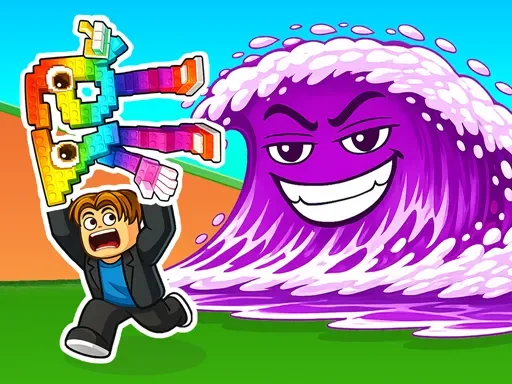
Tsunami Brainrots Online


Rating:
4.38
Played:
11,613
Tsunami Brainrots Online feels chaotic in the first minute, then strangely tactical once you understand its rhythm. You spawn into a colorful map filled with climbable structures, narrow paths, and scattered brainrot collectibles, while a giant wave keeps rolling forward and resets bad decisions quickly. The pressure is immediate, but that is exactly why the game works in a browser session: every run gives you a clear goal, visible danger, and constant choices about when to push deeper and when to turn back.
Unlike simple endless runners, this game layers movement skill with route planning. You are not only escaping water. You are collecting items, managing inventory, checking your return path, and deciding whether one more detour is worth the risk. That loop is what keeps rounds interesting. Two players can share a local session, while solo players can still run in an online environment where you observe other routes and react in real time.
How a Typical Run Unfolds
Most successful runs begin with quick map reading instead of blind sprinting. The opening seconds are about identifying vertical escape options, nearby pickups, and safe return lines. As the tsunami advances, flat areas become traps, and platforms with clean jump spacing become your lifeline. If you grab collectibles without thinking about elevation, you usually lose them before banking progress.
The game rewards measured aggression. Going too safe can stall your progression, but greed is punished even faster. A good rule is to commit to short objective loops: collect a cluster, return, reposition, then push again. This keeps momentum while reducing the all-or-nothing feeling that causes most early frustration.
Why timing beats raw speed
Players often assume the fastest route is always the best route. In Tsunami Brainrots Online, the better choice is usually the route with fewer awkward landings and less crowding. Even a one-second delay at a choke point can cost an entire run when the wave closes space. Clean jumps and predictable turns beat desperate zigzags almost every time.
Playing on This Site Without Setup Friction
This browser version is built for quick access. You load the page, wait for the embed to initialize, and start immediately on desktop or mobile. There is no long onboarding sequence, so your first runs become your tutorial. Desktop keyboard-plus-mouse control is precise, while touch controls stay readable if you keep thumb placement stable and keep the wave in view.
If the game window feels cramped, maximize the play area before starting a serious run. Better visibility helps with platform spacing and incoming obstacles. Also close extra tabs if your device is struggling, because input delay hurts this game more than many puzzle or turn-based titles.
Control map to memorize early
Common controls reported across major portals are straightforward: move with WASD, jump with Space, interact with E, and steer the camera with mouse movement. Common portal mappings also include hammer on 1, bag on R, shop on T, rebirth on Y, and chat on C. In two-player mode, the second player usually moves with arrow keys and separate action keys. Learn bag and shop access early so progression feels less random.
Tactical Habits That Increase Survival Time
The first habit is vertical priority. Whenever you are uncertain, choose the path that gains height safely. High ground buys decision time, and decision time is the rarest resource in a tsunami chase game. The second habit is camera discipline. Many failures come from over-rotating the camera during a jump sequence, then landing slightly off-angle and slipping. Small camera corrections are safer than dramatic swings.
Third, use the bag and shop systems as part of your rhythm, not as emergency buttons. If you wait until panic, you make slower choices and misclick more often. Build the habit of checking inventory status during calm moments between wave pressure spikes. Finally, watch other players when available. Even without direct coordination, you can learn efficient ladders, timing windows, and escape lines by observing where experienced players do not go.
Mistake recovery when a run goes wrong
Bad jumps happen. The key is not to force a hero correction that burns all spacing. If you miss a platform and still have a safe side path, reset your angle first and recover elevation in two controlled moves. When you lose valuable collectibles, resist the urge to immediately reclaim them from a dangerous zone. In many runs, accepting a small loss prevents a full wipe.
Release Context and Why Information Sometimes Differs
Tsunami Brainrots Online appears across multiple browser portals, and listings are not always identical. Gameflare shows the title as published on February 16, 2026 and tags it under action, multiplayer, and WebGL-style browser categories. Another large listing on gameVgames marks the release window as March 2026, names Cursora Labs as developer, and highlights desktop, mobile, and tablet support. Differences like this are common for portal ecosystems where mirrored builds, localization pages, and metadata updates happen on separate schedules.
Despite those metadata differences, the core description is consistent: a fast survival loop built around outrunning a sweeping tsunami, collecting brainrot items, and balancing risk against safe banking. The game also sits inside the broader 2025-2026 wave of brainrot-themed obstacle and escape experiences, which explains its exaggerated humor, meme-styled characters, and high replay focus rather than deep narrative progression.
What makes it replayable after the novelty phase
Many meme-driven browser games lose interest quickly once the joke lands. This one holds attention longer because the movement decisions stay meaningful. Route selection, timing, and pressure management create enough variation that two sessions rarely feel identical. When you add two-player couch competition, even small mistakes become dramatic moments, which naturally creates rematch energy.
Common Questions
Is Tsunami Brainrots Online better solo or with two players?
Both modes are worth trying. Solo runs are cleaner for learning routes and timing, while two-player sessions add unpredictability and social pressure that can be very fun. If you are new, start solo for a few rounds, then switch to shared-screen once controls feel natural.
Do I need to collect everything I see to progress?
No. Prioritize collectibles that fit your current position and escape timing. Overcommitting to every pickup is the most common way to get trapped by the wave. Controlled, repeatable routes usually outperform risky full-map greed.
How do I improve quickly in the first 20 minutes?
Focus on three basics: clean jumps, stable camera movement, and early retreat decisions. Ignore advanced optimization at first. Once these fundamentals are consistent, your survival time and collected value will increase naturally.
Why does the game feel harder when many players are near me?
Crowding creates movement interference and visual noise. Shared lanes increase collision risk and reduce your margin for jump timing. When possible, choose slightly less crowded lines, even if they look longer, because they are often safer overall.
Are the portal release dates and ratings always accurate?
They are useful references, but not always synchronized across sites. Different portals may list different publication dates, ratings, or developer labels depending on update cadence and regional metadata. Treat those fields as approximate context rather than absolute history.
Can mobile players enjoy this game or is desktop strongly preferred?
Mobile is playable and convenient for short sessions, especially if your device runs smoothly. Desktop usually offers finer camera precision for tight platforming. If you want consistent high-score attempts, desktop input can feel more stable.
Why It Works as a Browser Session Game
Tsunami Brainrots Online succeeds because it combines instant readability with real decision depth. You can start in seconds, understand the danger immediately, and still discover better tactics over time. The wave supplies urgency, collectibles create objectives, and movement skill turns each run into a small strategy test. it is easy to launch and hard to put down after just one try.

Comments
Loading comments…